
1. Web Infrastructure Decision: Technology Selection That Determines Your Company's Future
When a company decides to build a new website, the first critical question it encounters is: "Should WordPress, the world's most popular content management system, be used, or should custom web software be developed from scratch specifically for the company?" This decision directly determines not only the initial development cost of the site, but also your business's security expenditures, page speed, SEO success, and digital growth flexibility for the next 3 to 5 years.
Two extreme views dominate the market: One side forces every project into ready-made WordPress templates, while the other issues astronomical custom software invoices even for a simple corporate introduction site. The correct approach is to analyze the company's actual business volume, integration needs, and data structure instead of dogmatic preferences; successful web design projects begin with this analysis.
Core Engineering Principle: There is no absolute concept called "the best technology"; there is "the right technology that provides the highest return on investment (ROI) for your company's current business model and budget."
2. WordPress Architecture: When Is It the Most Accurate and Rational Solution?
Powering approximately 43% of all sites on the internet (W3Techs), WordPress offers a unique ecosystem for content production, corporate promotion, blog management, and standard e-commerce (WooCommerce) requirements.
Fast Deployment
Since the core CMS is ready, a management panel or database is not coded from scratch; it is launched on corporate sites in 10-15 business days in a budget-friendly manner.
Easy Content Management
Your company's secretariat can add new service pages, reference photos, and blog posts without knowing a single line of code.
Clean Code & 90+ PageSpeed
At Alaska Medya, WordPress is established either with a lightweight ready-made theme adapted to the brand based on budget and needs, or with a custom block architecture written from scratch, targeting a 90+ PageSpeed score.
Global Ecosystem & Independence
Thanks to its open-source architecture, you are not dependent on a single agency; a different developer who knows WordPress can also take over and develop the infrastructure.
3. Custom Web Software: When Is It the Right Choice?
In cases where firm-specific business logic is in play that does not fit the molds of a standard content management system, custom software is often the most accurate alternative:
B2B Portals & ERP Integration
Software infrastructure that operates bidirectionally with dealer discounts, open account/direct debit system inquiries, and Logo, Mikro, SAP systems according to the API capabilities offered by these systems.
Lean Architecture & Smaller Attack Surface
Only the architecture required by the project runs. The attack surface narrows against automated scanning bots targeting common plugin vulnerabilities; however, secure coding, up-to-date server software, and regular security tests are still required.
High Traffic & Big Data Volume
In projects with heavy traffic and complex queries, database tables are designed according to needs and scaled together with the server infrastructure.
Code and Intellectual Property Transfer
Source codes written specifically for you are delivered with a written contract; the financial rights of the custom code and content are transferred to you, while third-party licenses are subject to their own terms.
4. Comparison Table: WordPress vs. Custom Software in 10 Core Criteria
To make your decision-making process tangible, we compared the two architectures across 10 technical and commercial dimensions:
| Evaluation Criterion | Alaska WordPress Architecture | Alaska Custom Web Software |
|---|---|---|
| 1. Initial Cost | Economic (Starts from 24.900 TL) | Investment-Oriented (60.000 TL+ depending on scope) |
| 2. Delivery Time | 10 - 15 Business Days (corporate site) | 30 - 60 Business Days (in Sprints) |
| 3. Panel Usability | Excellent (World-standard interface) | Customized simplified screens for the user |
| 4. ERP / CRM Integration | Basic REST API and Webhook | Comprehensive Bidirectional Integration (depending on ERP API) |
| 5. Plugin Dependency | Only essential 3-5 core plugins | Minimal Dependency (Original Code) |
| 6. Performance (PageSpeed) | 90+ score with proper optimization | 90+ Score (with full control) |
| 7. Security and Threat Surface | Requires WAF and regular updates | Smaller attack surface; requires secure coding and regular testing |
| 8. Scalability | Ideal for SMEs and mid-scale businesses | Scalable for High Traffic (depends on infrastructure) |
| 9. SEO Flexibility | Rich schema and plugin support | Full control, intervention in every HTML line |
| 10. Code Ownership & Transfer | Open source, any developer can manage | Source codes fully delivered to your company |
5. Which Option Is Right for Your Business? Decision Tree Analysis
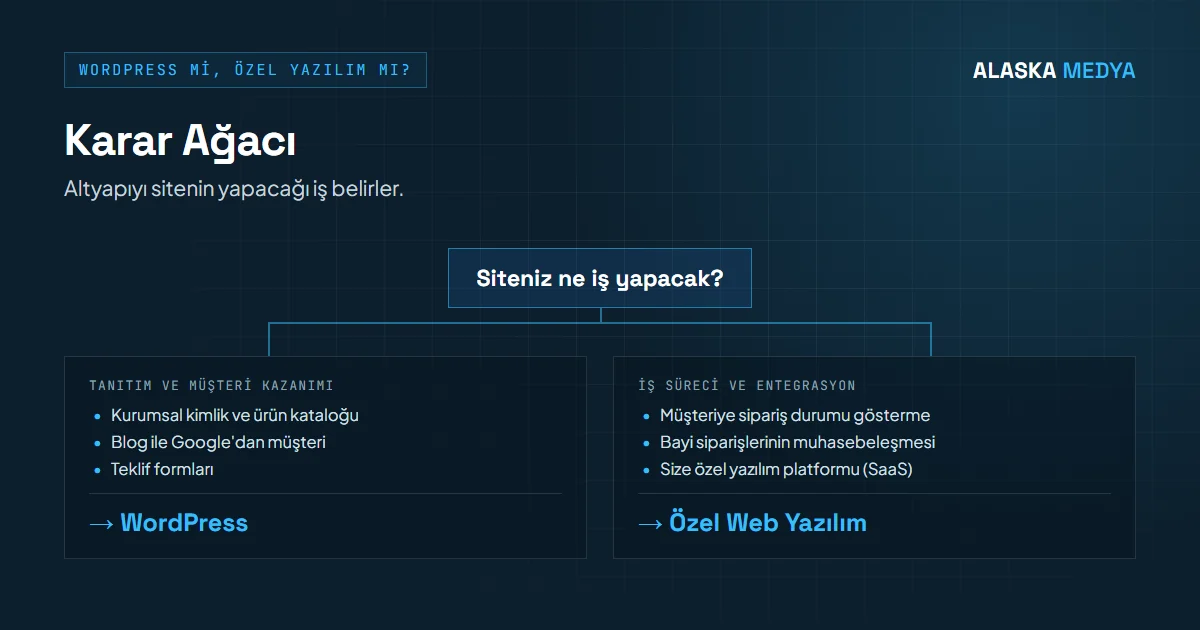
If your goal is to promote your corporate identity, showcase your product catalogs, attract organic customers on Google with sectoral blog content, and collect quote forms, you should opt for a professional WordPress infrastructure without unnecessarily spending high custom software budgets.
However, if you want to display your factory's production line order status to your customers, automatically account for your dealers' orders, or build a dedicated SaaS (Software as a Service) platform, standard content management systems will struggle in a short time. In such projects, what will carry your business into the future is a solid engineering infrastructure built with web software solutions tailored to business processes.
6. Security, Update Risks, and Server Layer
Whichever infrastructure you choose, the security of the system is directly proportional to the quality of the hosting server environment. If a WordPress site is not updated for 6 months and is hosted on cheap shared hosting, the risk of being attacked multiplies. Similarly, a custom-written system can also experience data leaks if it is not isolated with server-level firewall and SSL protection.
As Alaska Medya, in both architectures, we deliver our projects on corporate hosting, VPS, or VDS selected according to the project, with weekly backups, HTTPS with TLS 1.2/1.3 (free SSL certificate), and proactive secure infrastructure and server management assurance.