
1. Corporate Websites and Data Security in the Age of Digital Threats
Today, cyberattacks do not target only global holding companies or financial institutions. Automated Crawlers scan every website on the internet within seconds to catch an open port, an unmanaged plugin, or an unencrypted form transfer. Websites of SMEs and manufacturing industrial firms often face threats of data theft, ransomware, and joining spam botnets simply because they are perceived as vulnerable.
When a website is hacked, the damage is not just a technical collapse; it means losing search visibility after being flagged by Google with the label "This site may be hacked", blocking emails sent to existing customers, and damaging the company's commercial reputation. Therefore, the foundation of digital transformation must be laid with a secure web design infrastructure protected at every layer with armor.
Things to Keep in Mind: A significant portion of cyberattacks target SME-scale businesses; for companies whose data is stolen or that remain offline for days, customer loss and reputational damage often outweigh the cost of technical repair.
2. SSL/TLS Encryption: Why HTTPS Is Not an Option but a Necessity
Certificates colloquially known as "SSL" today operate with the TLS protocol (TLS 1.2/1.3); they protect all data packets flowing between the user's web browser and the server (passwords, quote forms, payment details) by encrypting them during transmission. Even if a malicious attacker intercepting this traffic listens in, they will only see meaningless character strings (Man-in-the-Middle protection).
Browser Trust Seal
Sites without an SSL certificate open in browsers with a red "Not Secure" warning. A significant portion of users who see this warning leave the site.
Google SEO Signal
Google uses HTTPS as a lightweight ranking signal; all other conditions being equal, sites with HTTPS can gain an advantage.
Transport Encryption
Contact information, order notes, and passwords entered by the user into form fields are encrypted while being transmitted between the browser and the server, protecting them from third parties. Card data, on the other hand, must be processed through a PCI-DSS compliant payment provider.
HTTP/2 & HTTP/3 Support
Modern web speed protocols (HTTP/2 and HTTP/3) only work over HTTPS. Without SSL, your site remains bound to the legacy and slow HTTP/1.1.
3. Shared Hosting Traps and Choosing the Right Hosting
In some cheap shared hosting packages on the market, hundreds of different websites are crammed onto a single physical server. Without adequate isolation, another site getting infected with a virus in this neighborhood environment can lead to the server's IP address being blacklisted and negatively affect other sites as well.
At Alaska Medya, however, we select corporate hosting, VPS, or VDS according to the project; setup, management, and support are handled by us. On the corporate hosting side, thanks to the LiteSpeed / CloudLinux infrastructure, each account operates within its own resource limits and file system isolation.
| Security Criterion | Some Cheap Shared Hosting Packages | Alaska Medya Corporate Hosting / VPS |
|---|---|---|
| Account Isolation | Limited or none (risk of being affected by a neighbor site) | Account-Based Isolation with CloudLinux |
| Server Software | Standard, non-cached configuration | LiteSpeed + Server-Side Caching |
| Attack Shield (WAF & DDoS) | Basic port filtering only | WAF + DDoS Protection |
| Backup Assurance | Irregular or at the mercy of the user | Weekly Automated Backups |
| Email IP Reputation | Shared IP reputation risk | Verified Delivery with SPF/DKIM/DMARC |
| Accessibility Target (Uptime) | Varies by package, often unspecified | 99.9% Uptime Target |
4. Corporate Email Continuity: 3 DNS Protocols and Outbound Filter Preventing Spam Flagging
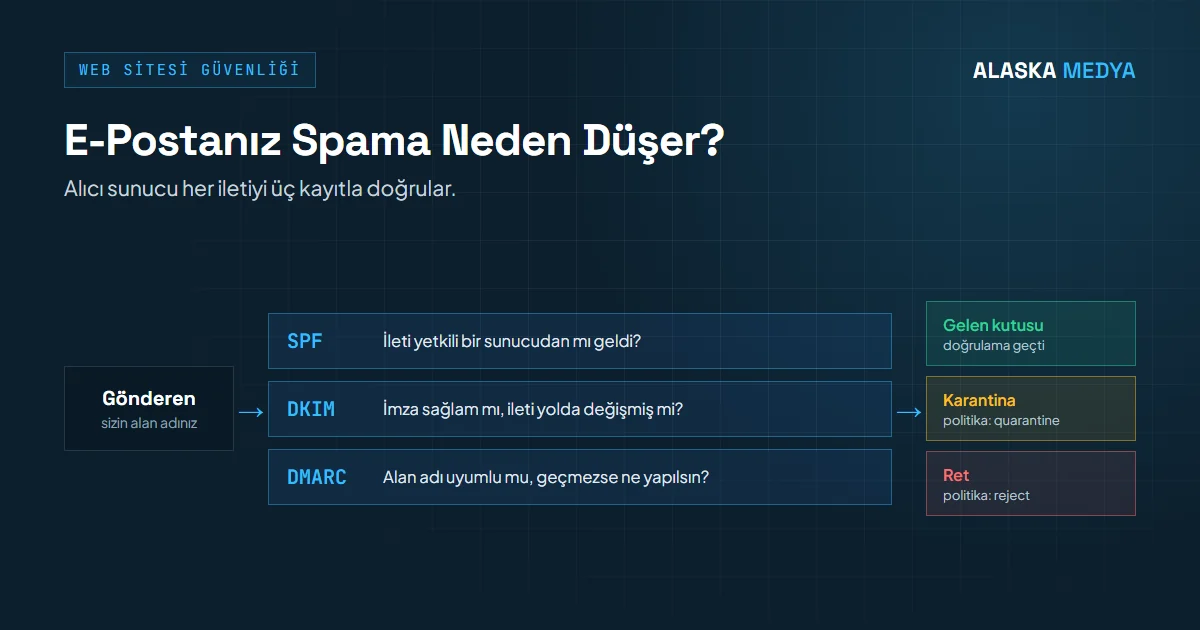
A price quote or draft contract sent to your customer falling into the recipient's "Junk / Spam" folder causes direct revenue loss and reputation erosion for your company. Starting from 2024 for Google (Gmail) and 2025 for Microsoft (Outlook), bulk senders sending more than 5,000 messages per day are required to have SPF, DKIM, and DMARC authentication; for other senders as well, the lack of these records significantly increases the risk of messages landing in the spam folder or being rejected.
Within the scope of corporate hosting and email services offered by Alaska Medya, the following 3 DNS protocols and outbound mail filter are configured as standard for every domain name:
SPF (Sender Policy Framework)
Publishes via DNS which servers are authorized to send emails on behalf of your domain name; the recipient server checks with this record whether the message originates from an authorized server. It provides primary protection against spoofing of your domain name together with DMARC.
DKIM (DomainKeys Identified Mail)
Adds a mathematical crypto signature at the server level to every email you send. The recipient server verifies that the email has not been tampered with in transit.
DMARC (Domain-based Message Authentication, Reporting and Conformance)
Audits the alignment of SPF and DKIM results with the visible sender domain name; instructs recipient servers on what to do with messages that fail authentication (monitoring only, quarantine, or rejection with p=reject) and reports phishing attempts.
Anti-Spam & Outbound Filter
Emails leaving the server are passed through outbound filters to reduce the risk of the IP being blacklisted and to increase deliverability.
5. Legal Dimension of Cyber Security: KVKK Article 12 Responsibilities
Website security is not just a technical preference but a legal obligation pursuant to the Personal Data Protection Law No. 6698. Article 12 of the Law mandates that data controllers take the necessary technical and administrative measures to ensure an appropriate level of security for the protection of personal data.
A data breach occurring in systems that perform unencrypted data transfers, are left vulnerable to database attacks, or are not isolated against unauthorized access may lead to the Board concluding during an investigation that sufficient technical measures were not taken, resulting in administrative fines; the breach must also be reported to the Board within 72 hours at the latest from becoming aware of it. Therefore, when planning your site's server infrastructure, engineering solutions fully compliant with KVKK and data security regulations on websites should be preferred.
Alaska Medya Planned Migration Process: We migrate your existing website and corporate email boxes hosted with another firm to the hosting infrastructure we manage through a planned transition that minimizes downtime while protecting your emails and data.