
Why Getting a Website Built Is Not Just a "Design Job"
The cornerstone of building trust in the digital world and winning new customers for a business is having a professional web design infrastructure. In modern B2B and corporate commerce, your customers, dealers, and business partners form their first impression of your company through your website. A site that loads slowly, has broken buttons on mobile devices, or features a non-working contact form will damage your brand's corporate prestige, no matter how established your firm is.
Thousands of web agencies and freelancers operate in the market. However, when you receive quotes, you will notice massive gaps ranging from 5,000 TL to 100,000 TL. The real truth behind the price difference lies in the coding quality used, search engine compatibility, security layers, and most importantly, the legal guarantee of the project. In this guide, we cover 10 essential criteria that you must audit before signing a contract, ensuring you don't throw your company budget away or suffer months of grievances.
Core Principle: A corporate website is not a one-time expense; it is your most profitable digital asset that sells on your behalf 24/7, collects inquiries, and represents your corporate reputation.
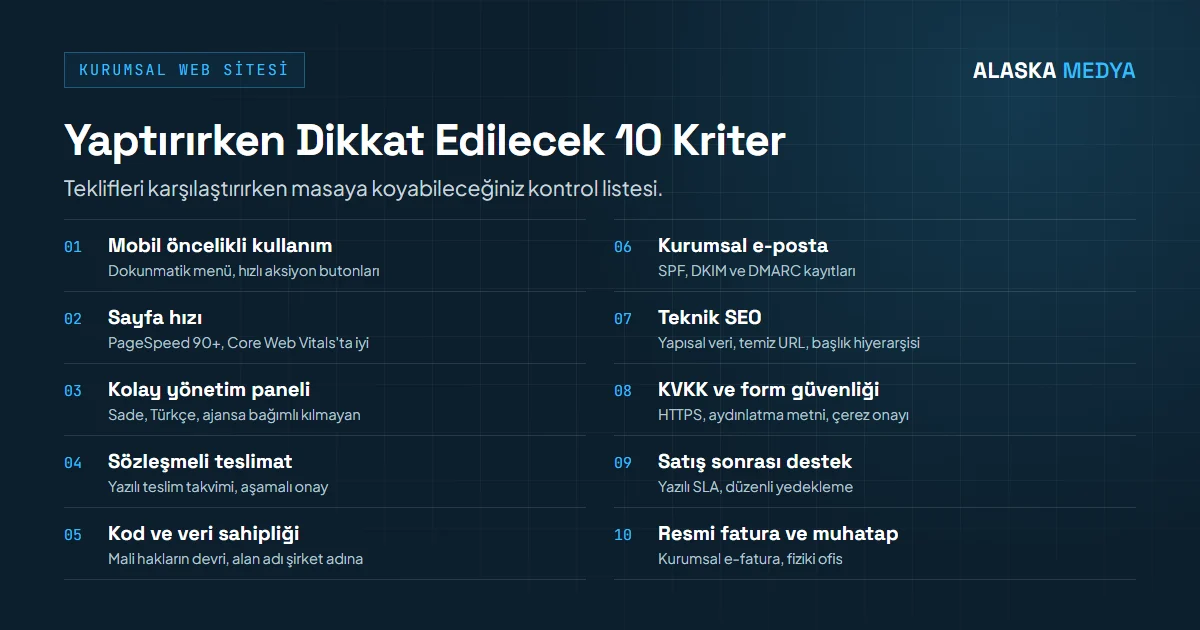
10 Criteria Summary Checklist (Executive Summary)
A quick comparison matrix you can put on the table when evaluating proposals or meeting with agencies:
| Criterion | Risk Faced If Ignored | Corporate Standard |
|---|---|---|
| 01. Mobile-First UX | A significant portion of mobile visitors bouncing from the site immediately | Mobile-First architecture, touch-friendly menu, and quick action buttons |
| 02. Page Speed (Core Web Vitals) | Dropping in Google rankings, wasting advertising budgets | PageSpeed 90+, good results in Core Web Vitals (LCP ≤ 2.5 sec, INP ≤ 200 ms, CLS ≤ 0.1) |
| 03. Easy Management Panel | Being dependent on the agency even for a minor text or image change | Simple, modular, and Turkish block content management panel |
| 04. Contractual Delivery | Never-ending projects dragging on for months, calls going unanswered | Delivery schedule defined in a written contract and phased approvals |
| 05. Code & Data Ownership | Holding your site hostage when you want to change servers tomorrow | Transfer of financial rights for custom code and content, database delivery, and domain registration in the company's name |
| 06. Corporate E-Mail | Your quotes and invoices landing in customers' spam folders | Properly configured SPF, DKIM, and DMARC records, hosting tailored to the project |
| 07. Semantic Technical SEO | Google bots failing to crawl your site, missing out on search results | Schema.org JSON-LD structured data, clean URLs, and H1-H3 hierarchy |
| 08. KVKK & Form Security | Law on the Protection of Personal Data violations and heavy administrative fines | TLS (SSL) certificate / HTTPS, disclosure text, and consent for non-essential cookies |
| 09. Post-Sales SLA | Having no one to contact when a technical error occurs after the site goes live | Written SLA (Service Level Agreement) and periodic system backups |
| 10. Official Invoice & Counterparty | Transferring money to a personal account, making it harder to seek legal recourse in case of a dispute | Corporate e-invoice, tax-registered company, and physical office guarantee |
Step-by-Step 10 Criteria: A Safe Roadmap for Your Company
1. Mobile-First Architecture and Touch UX
The vast majority of traffic coming to corporate websites now occurs via smartphones. Decision-maker executives, factory managers, or procurement officers examine your firm from their mobile phones not at their desks, but in the field or between meetings. Your site's mobile version should not be a downscaled copy of the desktop version. A touch menu (drawer), one-click call button, direct WhatsApp communication bridge, and quote forms easily filled out with a finger are mandatory standards.
2. Core Web Vitals Performance and Page Load Speed
Google evaluates Largest Contentful Paint (LCP), Interaction to Next Paint (INP), and Cumulative Layout Shift (CLS) as part of page experience signals. A significant portion of users leave slow-loading sites without waiting. Heavy animation libraries, uncompressed massive PNG images, and poorly maintained pre-made themes make your site sluggish. The target for your corporate site should be PageSpeed 90+ on desktop and mobile, and good thresholds in Core Web Vitals (LCP ≤ 2.5 sec, INP ≤ 200 ms, CLS ≤ 0.1).
3. Easy and Independent Turkish Content Management Panel
Having to email your agency and wait for days every single time you want to add a new product, upload a reference project, or update your address is unacceptable. Some developers leave complex or English panels behind to keep the client dependent on them. A corporate website must feature a simple, modular, and secure management panel where your company secretary or marketing officer can easily create pages without knowing any code.
4. Written Contract and Firm Delivery Date Commitment
The biggest complaint in the web industry is projects promised to be "delivered in 2 weeks" that drag on for 6 months. Proving verbal promises is quite difficult. Before starting the project, a written contract must be signed outlining the number of pages, design revision rights, modules to be added, and the delivery date. Clearly stating in the contract how to proceed in the event of a potential delay also protects your business.
5. Code and Content Rights, Database, and Domain Ownership
Some ready-made website rental platforms or individual designers register the domain under their own name or fail to deliver the source code. Your company is forced to pay rent to these individuals every month or year; when you want to leave, you might not be able to migrate your site. Once the project is completed and payment is made, the domain must be registered in your company's name, server cPanel/Plesk access details and custom source files must be delivered, and the financial rights to this code and content must be transferred to you. Third-party licenses (themes, plugins) are subject to their own terms.
6. Corporate E-Mail Security (DMARC, SPF, DKIM) and Hosting
Having the quote email you send to a customer land in the "Junk / Spam" folder is a disaster for your business. On very cheap and poorly managed servers, the IP address can end up on a blacklist, and your emails may not be delivered. Corporate web design services require selecting a hosting infrastructure suitable for the project and properly configuring SPF, DKIM, and DMARC DNS records.
Prestige and Sales-Oriented Design Standard for Corporate Companies
As Alaska Medya, we implement these 10 criteria as a standard for all our clients, from industrial manufacturers to export companies, law firms to health centers. In our professional corporate web design solutions that will reflect your company's vision into digital, build authority on Google, and create new business opportunities via inquiry forms, we never use nulled themes or external plugins with uncertain security; depending on the budget and timeframe, we either adapt a licensed ready-made theme to your brand or design the interface from scratch.
We choose the infrastructure according to the project (WordPress or custom coding), stripping it of unnecessary code and plugins to target PageSpeed 90+ on desktop and mobile. The corporate package includes first-year hosting, corporate e-mail, domain name, and maintenance/support; the TLS (SSL) certificate is free of charge.
The Remaining 4 Criteria: Invisible Yet Vital Infrastructure Elements
7. Semantic Technical SEO and Structured Data (Schema JSON-LD)
It is not enough for your site to look great from the outside; Google bots need to understand your site and categorize it correctly. Heading hierarchy (H1, H2, H3), clean and logical URL structure, Open Graph tags, and most importantly, semantic Schema coding like Organization, Service, and LocalBusiness that introduce your company's official title, address, and services to Google must be part of the core infrastructure.
8. KVKK, Cookie Policy, and Contact Form Security
Under the Law on the Protection of Personal Data (KVKK) in Turkey, any name, phone number, and email data collected through websites falls within the scope of the law. Your site must feature a disclosure text and cookie policy, and user consent must be obtained for non-essential cookies; explicit consent must be requested only for truly necessary processing and separately from the disclosure. While KVKK does not prescribe a specific technology, it mandates appropriate security measures; encrypting data transmitted through forms via HTTPS with a TLS (SSL) certificate is the foundation of these measures.
9. Post-Sales SLA and Regular Backups
Not being able to reach the developer after the website goes live is a chronic wound of the sector. You should be able to reach your direct technical contact in case of a server failure, domain renewal, or urgent content intervention. When working with a corporate agency, a weekly/daily cloud backup schedule and emergency intervention commitment (SLA) must be tied to the specification document.
10. Official Corporate E-Invoice and Commercial Transparency
Money sent to individual accounts with the description "web service fee" makes it difficult for you to seek legal recourse in the event of a dispute. The company you receive service from being a tax taxpayer, having clear trade registry information, and issuing an official e-invoice on behalf of your company are important both for accounting and for proof in case of any dispute.
Comparison: Amateur Approach vs. Alaska Medya Corporate Standards
The tangible reflections of these 10 criteria on your business's future and brand perception:
| Service Item | Amateur Approach in the Market | Alaska Medya Corporate Standards |
|---|---|---|
| Interface Architecture | Unlicensed or unmaintained, bloated ready-made templates | Custom UI/UX tailored to your brand's colors and corporate identity (adapted theme or scratch design) |
| Load Speed (LCP) | Slow loading (high bounce rate) | PageSpeed 90+, good results in Core Web Vitals |
| Delivery Guarantee | Verbal promises; unreachable phones and delays | Written contract and clear delivery schedule |
| Code Ownership | Dependency on an individual or platform, no code transfer | Financial rights to custom code and content, database and domain ownership |
| E-Mail Security | Cheap server; company emails landing in spam | Hosting infrastructure configured with SPF/DKIM/DMARC, suited to the project |
| Post-Sales Support | Phones closing down after project completion, zero SLA | 120+ active clients since 2016 and indefinite technical support |
How Should You Test Your Agency Before Signing a Contract?
After learning the 10 criteria, it is time to sit down at the table with the right agency. To understand whether the team in front of you is a corporate software agency or an intermediary using subcontractors, you need to ask the right questions. Before sitting at the contract table, you can review our checklist that will test the agency's technical competence, delivery guarantee, and reference transparency in our questions to ask when choosing a web design agency guide.
Frequently Asked Questions About Building a Corporate Website
Topics most frequently inquired by executives and business owners prior to project launch: